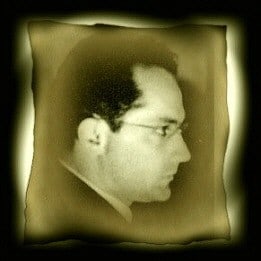
Varian Fry’s project was brought to an abrupt end in 1941, when he was arrested by the police and eventually deported. Mordecai Paldiel tells in his book Sheltering The Jews, Stories Of Holocaust Rescuers how Fry’s passport was confiscated in January 1941. In August 1941, a French police officer warned him that he was on the point of arrest unless he left France. When Varian Fry quotes paid no heed to the warning, he was arrested on August 27, 1941, given one hour to pack, conducted to the border, and turned over to Spanish authorities, with an expulsion order in his pocket.
After the war, he wrote two books about his experiences in Marseille, Assignment Rescue and Surrender On Demand, but he never received the acclaim that his remarkable courage merited. His heroic actions were considered with some suspicion by the FBI, which had kept a file on him throughout his life.
The US State Department wanted to maintain ‘good relations’ with the Vichy French and it seemed to help block Fry’s work. The US consulate confiscated his passport, and connived with the French fascists to have him expelled from Marseille for the crime of protecting “Jews and anti-Nazis”.
In his autobiography Fry later wrote:
“Almost immediately after the closing of the office, there began one of the most horrible manhunts in all history. Men, women and children of Jewish ancestry were rounded up by the police, packed into cattle cars, and sent off to Poland to be exterminated.”
Bitter, Varian Fry returned to the US and desperately tried to set off warning bells about the coming Holocaust. In the December 1942 issue of the The New Republic he wrote a scathing article called “The Massacre of the Jews: The Story of the Most Appalling Mass Murder in Human History” and called on the United States to allow the unrestricted entry of all who were suffering at the hands of the Nazis.
But his article went largely unnoticed – all his efforts proved futile. His homecoming was filled with humiliations: the Emergency Rescue Committee dismissed him, the army refused to allow him to enlist, and his wife divorced him. He had trouble finding jobs, and with time he slipped into obscurity. Mostly, he was depressed and September 13, 1967, he died alone of a heart attack in Connecticut where he was teaching high school Latin and Greek.
Varian Fry received one of France’s highest civilian honors, the Croix de Chevalier of the French Legion of Honor, five months before his death, but it was not until a few years ago that his contribution received the recognition that it deserved.
24 years after his death, in 1991, he received the Eisenhower Liberation Medal, in 1993-94 The U.S. Holocaust Memorial Museum mounted an exhibit titled “Assignment: Rescue, The Story Of Varian Fry and the Emergency Committee”, and in 1996 The Israeli Yad Vashem Memorial Museum, which investigates the history of the Holocaust, recognized his humanitarian exploits and accorded him their highest accolade: he was named posthumously as one of the Righteous Among The Nations, an honor recognizing non-Jews for rescue efforts during the Holocaust. A tribute never before accorded to any American and an honor Fry shares with Oscar Schindler and Raoul Wallenberg among others. At the ceremony in Jerusalem, Warren Christopher, Secretary of State at the time, apologized for then-Secretary of State’s treatment of Varian Fry:
“Regretfully, during his lifetime, his heroic actions never received the support they deserved from our government. Even today, Varian Fry’s tale of courage and compassion is too little-known in the United States.”
In 1998, Fry was one of the few also awarded Commemorative Citizenship of the State of Israel.
In October 2000, the small plaza in front of the U.S. Consulate in Marseille was renamed Place Varian Fry in recognition of his heroic efforts.
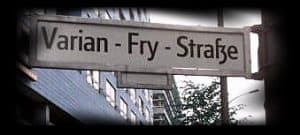
The city of Berlin has honored Varian Fry by naming a street leading to the Potzdamer Platz Varian-Fry-Straße.